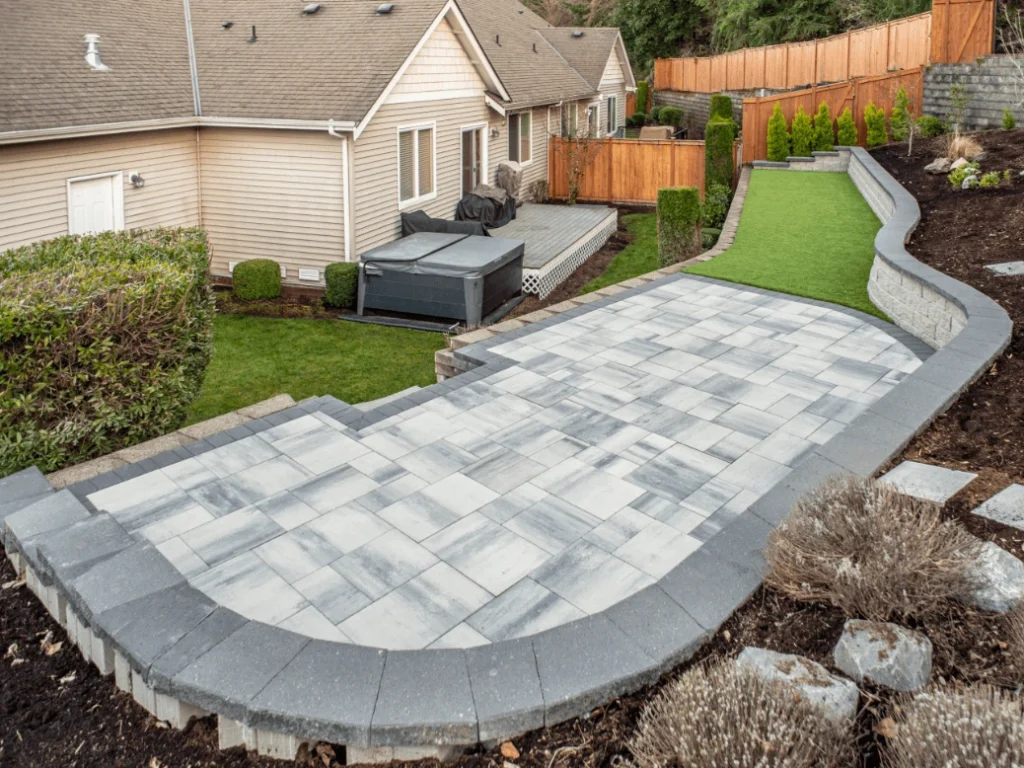
Patios and walkways are often treated as decorative features, but they play a much bigger role around a property.
A properly installed patio creates usable outdoor living space. Walkways provide safe access between entrances, driveways, yards and other areas. Both surfaces can also influence how rainwater moves around the home.
When patios or walkways begin sinking, cracking or holding water, homeowners may initially see the problem as cosmetic.
In many cases, however, visible deterioration is a sign that something is happening underneath the surface.
Poor drainage, base erosion, soil movement, tree roots and freeze-thaw cycles can all contribute to hardscape failure.
Recognizing these problems early can help homeowners repair localized damage before larger sections require reconstruction.
1. Sunken Pavers
One of the most common problems with paver patios and walkways is settlement.
A few pavers may gradually sink below the surrounding surface, creating dips and uneven areas.
This can happen when the base underneath loses support.
Common causes include:
- Poor initial compaction
- Water washing away base material
- Soil settlement
- Drainage problems
- Heavy loads
- Freeze-thaw movement
Simply adding sand underneath a sunken paver may temporarily improve the surface, but recurring settlement usually indicates that the base needs attention.
The affected pavers may need to be removed so the underlying material can be rebuilt and properly compacted before the surface is reset.
2. Uneven Walkway Sections
Walkways should provide a relatively smooth and predictable walking surface.
When one section rises or sinks relative to another, it can create a trip hazard.
Uneven walkways may develop because of:
- Tree roots
- Frost heave
- Soil settlement
- Erosion
- Poor base preparation
- Drainage problems
Homeowners should pay particular attention to walkways near:
- Front entrances
- Steps
- Driveways
- Basement doors
- Patios
These transition areas receive frequent foot traffic and may become especially hazardous when surfaces move.
Professional patio and walkway repair services can evaluate not only the visible surface but also the base, slope, drainage and surrounding transitions that may have contributed to the movement.
3. Cracked Concrete
Concrete patios and walkways can develop cracks for many reasons.
Some minor cracking may occur naturally as concrete cures and responds to temperature changes.
Other cracks indicate more substantial movement.
Potential causes include:
- Ground settlement
- Poor base support
- Freeze-thaw cycles
- Tree roots
- Drainage
- Heavy loads
Homeowners should pay particular attention to cracks that:
- Continue widening
- Become uneven from one side to another
- Reappear after patching
- Extend through several areas
- Allow water underneath the slab
A small stable crack may be repairable.
When a slab has significantly settled or broken into several unstable sections, replacement may make more sense than continued patching.
4. Water Pooling on a Patio
One of the most important warning signs is standing water.
A patio should generally be constructed with enough slope to move rainwater toward an appropriate drainage area.
If water repeatedly forms puddles, the surface may have:
- Settled
- Lost its original slope
- Been installed incorrectly
- Developed low sections
Standing water can create several additional problems.
It can contribute to:
- Ice formation during winter
- Algae or moss growth
- Base saturation
- Joint erosion
- Paver settlement
- Foundation moisture
Water pooling near the house deserves particular attention.
5. Patios Sloping Toward the Foundation
A patio does more than provide outdoor living space.
Its slope can directly influence foundation drainage.
When a patio pitches toward the house, rainwater may be directed toward:
- Foundation walls
- Basement windows
- Door thresholds
- Wall-floor joints
During heavy storms, the amount of runoff can be significant.
Homeowners who experience basement moisture after rain should inspect nearby patios and walkways as part of the investigation.
Correcting surface slope can sometimes be just as important as waterproofing the location where water appears indoors.
6. Missing Joint Sand
Paver installations rely on material within the joints between individual units.
Over time, joint material may disappear because of:
- Rain
- Pressure washing
- Surface runoff
- Poor installation
- Normal wear
When joints lose too much material, pavers may become less stable.
Homeowners may notice:
- Wider joints
- Loose pavers
- Weed growth
- Ant activity
- Surface movement
Restoring joint material can be part of routine paver maintenance.
However, if the pavers themselves are sinking or moving significantly, the base should also be evaluated.
7. Pavers Spreading at the Edges
A properly installed paver patio or walkway usually includes some form of edge restraint.
This helps keep the individual units from moving outward.
When the edge fails, homeowners may notice:
- Gaps widening
- Border pavers shifting
- Corners moving outward
- Joint material disappearing
- Surface alignment changing
Repair may involve resetting the affected pavers and restoring the edge restraint.
Ignoring spreading edges can allow movement to gradually work farther into the surface.
8. Loose Natural Stone
Stone patios and walkways can create attractive, durable outdoor spaces.
However, individual stones may loosen when:
- Mortar deteriorates
- Bedding material moves
- Water enters beneath the surface
- The base settles
- Freeze-thaw cycles create movement
Loose stone on a walkway or step transition can become a safety concern.
Localized stones can often be reset if the surrounding area remains stable.
When many stones loosen at the same time, there may be a larger base or drainage issue.
9. Crumbling Mortar Between Stones
Mortared stone patios and walkways may develop deteriorating joints.
The mortar may begin:
- Cracking
- Flaking
- Falling out
- Separating from stone edges
Normal weather exposure contributes to this deterioration.
Water and freeze-thaw conditions can accelerate it.
Localized repointing may restore stable stonework, but widespread failure should prompt an investigation into drainage and movement beneath the surface.
10. Moss and Algae Growth
Green growth on a patio is not always merely an appearance problem.
Moss and algae often develop where surfaces remain damp for extended periods.
Shaded areas naturally dry more slowly, but recurring growth may also reveal poor drainage.
These areas can become slippery, particularly after rain.
Cleaning the surface may improve appearance, but homeowners should also determine why the area remains wet.
11. Water Washing Out the Base
Surface runoff can gradually remove material underneath patios and walkways.
This process may be difficult to see until settlement develops.
Signs can include:
- Pavers sinking near edges
- Voids forming underneath concrete
- Soil washing onto nearby areas
- Gaps appearing near borders
- Repeated settlement after repairs
Correcting the drainage route is often necessary before rebuilding the damaged surface.
Otherwise, new base material may simply wash away again.
12. Tree Roots Lifting Walkways
Trees can create beautiful landscaping, but their roots can sometimes interfere with hardscapes.
As roots grow, they may lift:
- Pavers
- Concrete slabs
- Stone walkways
The result can be abrupt height changes.
Root-related repairs should be approached carefully.
Removing large roots may affect tree health or stability, while simply resetting the walkway without addressing root growth may result in future movement.
The best solution depends on the tree, location and extent of damage.
13. Freeze-Thaw Heaving
Cold-weather regions present additional challenges for hardscaping.
When moisture beneath a patio or walkway freezes, it expands.
This can push surface materials upward.
When temperatures rise, the ground thaws and materials may settle again.
Repeated cycles can contribute to:
- Uneven pavers
- Cracked concrete
- Loose stone
- Failed mortar
- Shifting edges
Good drainage and proper base preparation can help reduce the amount of moisture trapped beneath the surface.
14. Separation Where Walkways Meet Steps
Walkways frequently connect directly to stoops and exterior stairs.
These areas should transition smoothly.
When the walkway settles independently from the steps, a gap or height difference can develop.
This can create:
- Trip hazards
- Water collection
- Broken edges
- Loose pavers
Repairs should consider both structures rather than treating only the visible gap.
A walkway that continues settling can eventually damage a repaired step transition again.
15. Gaps Between a Patio and the House
A growing gap between a patio and foundation can indicate settlement.
Water may enter the opening and travel beneath the patio or toward the foundation.
Homeowners should monitor whether:
- The gap is increasing
- Nearby pavers are settling
- Water disappears into the opening
- Basement moisture appears nearby
Simply filling the gap with sealant may not solve the problem if the patio continues moving.
16. Repeated Repair Failure
A patio repaired repeatedly in the same location is sending an important message.
The visible surface may not be the main problem.
Imagine several pavers that sink every spring.
They are lifted and reset.
By the following year they have sunk again.
The repeated settlement suggests that something underneath remains unstable.
Possible causes include:
- Poor drainage
- Weak base material
- Erosion
- Soil movement
- Water discharge nearby
A more lasting repair usually addresses the underlying cause.
Why Drainage Is So Important
Many patio and walkway failures eventually lead back to water.
Water can enter beneath hardscaping from:
- Rain
- Downspouts
- Nearby slopes
- Irrigation
- Groundwater
- Snowmelt
When water has nowhere appropriate to go, it may:
- Saturate the base
- Erode supporting material
- Freeze beneath surfaces
- Flow toward the foundation
For properties experiencing persistent runoff or groundwater problems, French drain and exterior drainage solutions may sometimes form part of a broader hardscape repair strategy.
The specific drainage solution should always depend on where the water originates and where it can safely be redirected.
Repair or Replace?
One of the biggest questions homeowners face is whether an existing patio or walkway can be repaired.
Repair often makes sense when:
- Damage is localized
- Most of the surface remains stable
- Materials are reusable
- Drainage can be corrected
- Base failure affects only a small section
For example, a limited area of sunken pavers can often be removed, the base repaired and the original units reset.
Replacement may be more practical when:
- Settlement affects large sections
- Cracking is widespread
- The base has failed throughout
- Drainage is poor across the entire surface
- Materials are extensively damaged
- The layout no longer works
- Previous repairs repeatedly fail
A good contractor should evaluate both options rather than automatically recommending complete replacement.
Why Pavers Are Often Repairable
One advantage of individual pavers is that sections can be lifted without necessarily destroying the surrounding surface.
This allows contractors to access the base underneath.
Repairs may involve:
- Removing affected pavers.
- Excavating unstable material.
- Restoring the base.
- Compacting the area.
- Resetting the pavers.
- Restoring joints and edges.
When existing pavers remain in good condition, many can be reused.
Concrete Repairs Require a Different Approach
Poured concrete behaves differently because it forms larger continuous slabs.
Small cracks may be patchable.
Localized broken sections may sometimes be replaced.
However, significant settlement can make repair more complicated.
The decision should consider:
- Crack depth
- Slab movement
- Surface condition
- Base stability
- Drainage
Applying a cosmetic coating over unstable concrete does not stop the slab underneath from moving.
Don’t Forget About Surface Slope
A patio can look almost perfectly level while still having a small intentional slope.
That slope is important.
Outdoor surfaces generally need to move water somewhere.
Completely flat areas may retain water.
Incorrectly sloped areas may direct it toward the house.
When repairing hardscapes, contractors should check where runoff will travel after the work is complete.
Patios and Retaining Walls Can Affect Each Other
A patio located near a retaining wall requires careful drainage planning.
Water moving across the patio may enter the soil behind the wall.
Likewise, drainage from behind a retaining wall may affect the patio base.
Signs of interconnected problems include:
- Patio settlement near the wall
- Wall movement
- Joint washout
- Standing water
- Soil erosion
These structures should sometimes be evaluated together rather than repaired independently.
What Homeowners Can Inspect Themselves
A simple visual inspection can reveal many developing problems.
Walk slowly across the patio and walkway.
Look for:
- Rocking pavers
- Cracks
- Loose stones
- Uneven transitions
- Missing joint material
- Edge movement
After rainfall, check for:
- Standing water
- Runoff toward the house
- Water entering joints
- Soil erosion
- Wet areas around the foundation
Repeating this inspection each spring can help identify problems before they become more extensive.
Don’t Ignore Trip Hazards
Uneven walkways are not only cosmetic problems.
A raised slab, loose stone or sunken paver can cause someone to trip.
Entrances and frequently used walkways deserve particular attention.
Repairing these areas can improve:
- Safety
- Accessibility
- Appearance
- Drainage
Sometimes a relatively small localized repair can make a major difference.
Planning a New Patio or Walkway
Many of the problems found in older hardscapes can be avoided during installation.
A new project should consider:
- Excavation depth
- Base material
- Compaction
- Drainage
- Surface slope
- Edge restraints
- Material selection
- Step transitions
- Foundation clearance
The visible paver, brick, stone or concrete surface is only one part of the project.
What happens underneath often determines how well it performs over time.
When to Call a Professional
Professional evaluation may be worthwhile when:
- Settlement continues
- Large cracks appear
- Water consistently pools
- The surface slopes toward the house
- Several pavers or stones become loose
- A walkway develops significant trip hazards
- Repairs repeatedly fail
- Drainage problems affect the foundation
For homeowners across New York and New Jersey, Optane Masonry and Home Improvements provides patio, walkway, paver, stone, concrete and related exterior masonry repair and installation services.
Final Thoughts
Patio and walkway problems should not automatically be dismissed as normal aging.
A single loose paver may require only a small repair.
But widespread settlement, recurring cracks, standing water, spreading edges or repeated repair failures can indicate deeper problems involving the base or drainage.
The key is identifying why the surface changed.
Repairing the cause rather than simply covering the symptom can help extend the life of the hardscape and reduce the likelihood of having to repair the same area again.
A well-built patio or walkway should do more than improve curb appeal.
It should remain stable, safe and properly drained while working with the rest of the property for years to come.